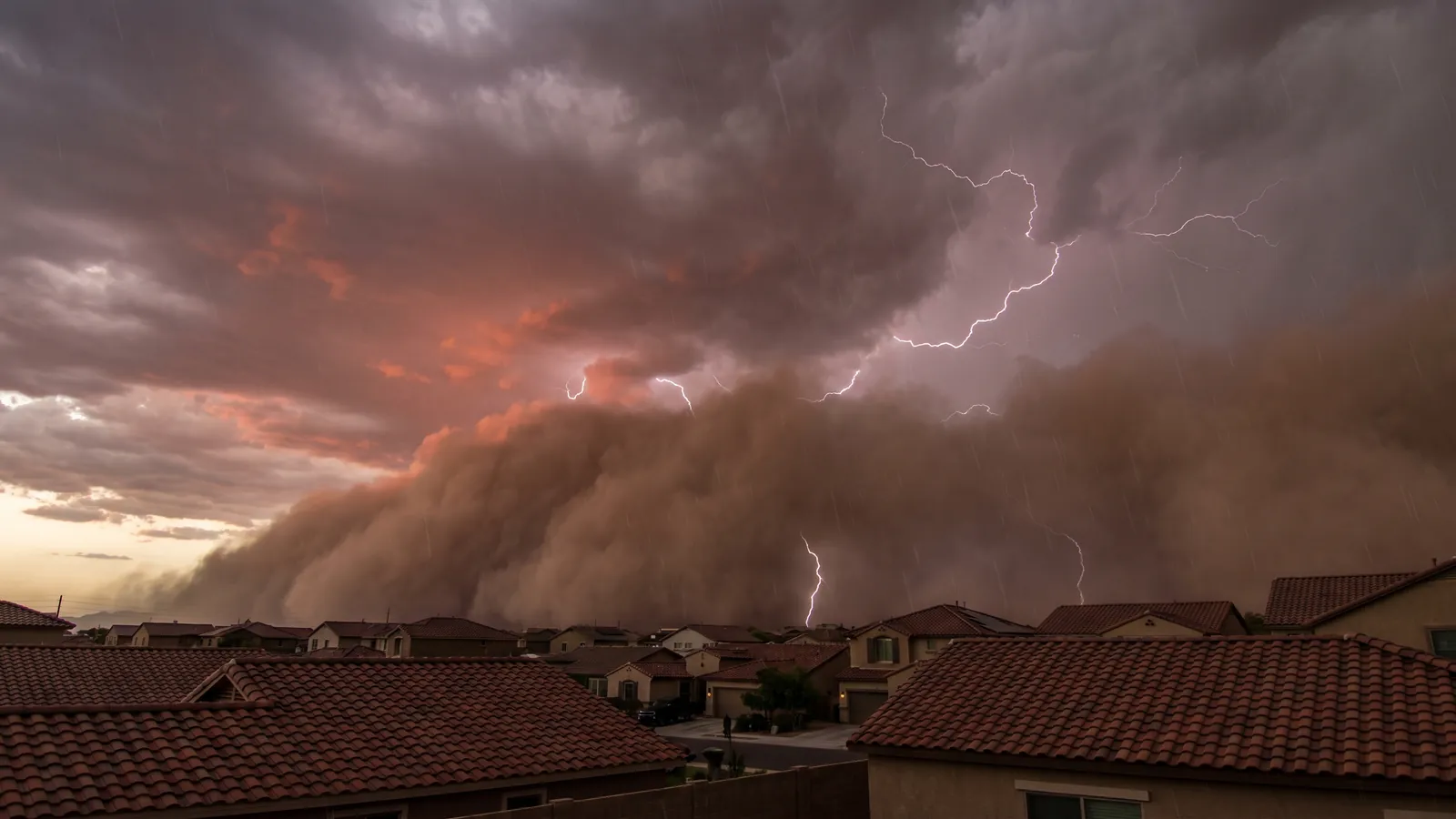
What the monsoon is
Arizona's monsoon is a shift in the wind: from mid-June through September, moist air flows up from the Gulf of California and the Gulf of Mexico, and on hot afternoons it builds into thunderstorms over the high country that collapse toward the Valley floor after dark. The National Weather Service fixed the season's dates as June 15 to September 30 in 2008. Surprise gets most of its 7 inches of annual rain in those fifteen weeks, usually an inch at a time in storms that last half an hour. For roofs, the rain isn't the problem. It's what comes with it.
What it does to roofs
- Microbursts. A collapsing thunderstorm drops a column of cold air that hits the ground and spreads out at 60 to 100 mph — straight-line wind, not a tornado, but just as hard on a roof. Surprise's building code designs for 105 mph. Microbursts lift ridge and hip tiles whose mortar died years ago, slide field tiles off their clips, crease and tear shingles, and peel foam coatings at the edges.
- Haboobs. The dust wall ahead of the outflow — 3,000 to 4,000 feet high on August 25, 2025, with 70 mph gusts at Sky Harbor — sandblasts foam coatings, packs fine silt into tile laps, valleys and gutters, and dams the next rain.
- Hail. Less common than in the Midwest, but it happens, and the Valley's worst storm — October 5–6, 2010, three-inch stones, $2.7 billion — was the costliest weather event in Arizona history. Inch hail has been reported on the ground near Surprise in 2018, 2019 and 2025, and half-dollar hail in August 2026. Hail cracks tile corners, bruises shingles, and punctures foam.
- Cloudbursts. An inch in thirty minutes overwhelms clogged scuppers on flat roofs and clogged valleys on tile roofs, and water goes where it shouldn't.
The last three summers
- July 24, 2024A West Valley microburst hit 77 mph, tore the roof off an apartment building and knocked out power to 31,000.
- August 25, 2025A 3,000–4,000-foot haboob crossed the Valley with 70 mph gusts at Sky Harbor and 50–65 mph across the metro; Terminal 4's roof was damaged.
- September 25–27, 2025Sky Harbor's wettest day since 2018 (1.64 inches); 1 to 1.5-inch hail at Peoria and Sun City. The Attorney General issued a post-storm contractor-fraud alert on September 29.
- November 19–20, 2025An off-season storm covered streets in Glendale and Peoria with hail and collapsed part of the Desert Sky Mall roof.
- August 9–10, 2026An 80 mph downburst in Glendale and 60–80 mph gusts across the West Valley sheared roofs off mobile homes at Palm Shadows, cut power to 52,000, and dropped half-dollar hail near Surprise.
- August 19–20, 2026A 'Category 2' haboob with 68 mph gusts and 17,000 outages.
- August 30, 2026The Weather Service warned Surprise, Sun City, Sun City West, El Mirage and Waddell of 60 mph winds and 'damage to roofs.'
- September 2026A microburst damaged shelter roofs at an animal sanctuary in Surprise.
After a storm: what to check
From the ground, with binoculars if you have them: ridge and hip tiles that have shifted or are missing; field tiles sitting crooked or slid down; broken tile on the ground or in the gutters; shingle tabs lifted or torn; blue sky where there shouldn't be any. Inside: any new stain on a ceiling, especially after the next rain. On a foam roof: standing water two days later, the coating peeled back at an edge, dimples from hail. Then call for the free storm inspection — we photograph the damage with the date and give you a report that ties it to the storm, which is what a claim needs.
Before the next one
Have the ridges and hips checked and re-set on a wind-rated system if the mortar is gone. Clear the valleys, scuppers and gutters of haboob silt in early June. Recoat a foam roof that's due before the season rather than after. Trim the palo verde and eucalyptus limbs that hang over the roof. And know that anyone knocking on your door the morning after a storm offering to 'handle the deductible' is breaking Arizona law — A.R.S. 32-1158.02 — and that you have four business days to cancel anything you sign.
Common questions
Does homeowners insurance cover monsoon damage?
Wind and hail damage, yes — it's sudden, accidental damage under nearly every Arizona policy, usually subject to a separate wind/hail deductible of 1–2% of the dwelling coverage. Wear and tear that the storm merely exposed is not. Documentation that separates the two is what makes a claim go through.
Why did my ridge tiles blow off when my neighbor's didn't?
Mortar age and exposure. Ridge mortar from the late 1990s has dried, cracked and fallen away on most Surprise roofs, leaving the tiles sitting loose; the west- and southwest-facing roofs take the outflow first. A foam-and-clip ridge system holds where mortar doesn't.
Can I file a claim for hail that didn't cause a leak?
Yes, if the hail cracked tile or bruised shingles — the damage is to the roof, whether or not it has leaked yet. We count and photograph the hits so the adjuster sees the storm damage rather than 'a few old tiles.'
How long do I have to file?
Usually a year or more from the date of loss under Arizona policies, but don't wait — later storms muddy the picture and cracked tile exposes felt that fails faster every week.
Is a tornado possible here?
Rarely; Arizona averages a few weak ones a year statewide. The microburst is the West Valley's real wind event, and it does the same thing to a roof.
Related: Monsoon and hail damage · Emergency roof repair · Insurance claims · Arizona roof insurance claims guide