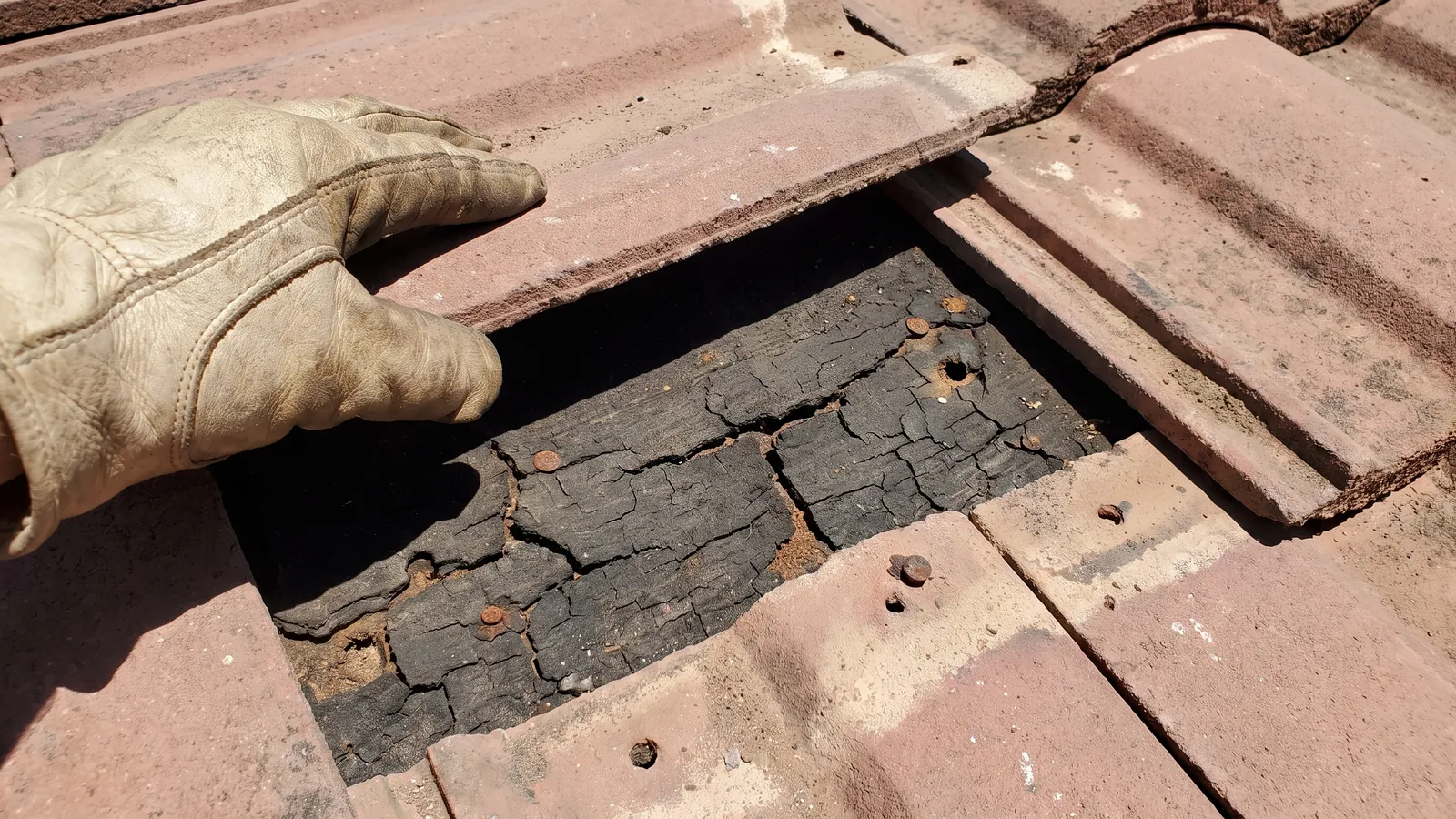
What's under your tile
A concrete tile roof is two systems. The tile is the armor: it takes the sun, the hail, the foot traffic and the wind, and it lasts 40 to 50 years. Under it, nailed or stapled to the plywood deck, is the underlayment — a membrane that sheds the water that gets past the tile. Tile laps aren't watertight; wind-driven monsoon rain blows under them all the time, and that's fine, because the underlayment carries it down to the eave. The underlayment is the roof. The tile is what protects the roof.
On nearly every house built in Surprise between 1996 and 2008 — Sun City Grand, Kingswood Parke, Mountain Vista Ranch, Ashton Ranch, the first phases of Surprise Farms, Sierra Montana and Marley Park — that underlayment is 30-pound asphalt-saturated felt, sometimes doubled. It was the standard of its day and it's a perfectly good product in Ohio. Under a tile roof in Surprise it sees 150 to 190°F on a July afternoon, 111 days a year over 100°F, and single-digit humidity. The asphalt oils that keep felt flexible bake out, the paper dries, and somewhere between year 15 and year 25 it turns brittle and cracks along every lap and at every nail — while the tile above it looks exactly as it did on move-in day.
How it fails
- At the eaves first. The bottom course gets the most sun and the most water. Felt along the eaves is usually the first to crack, and a slipped first-course tile — because the rusted bird stop let it slide — exposes it to direct rain.
- In the valleys. Valleys carry the most water and the most debris. Dust from haboobs packs in, holds moisture, and the felt rots from the top down.
- At penetrations. The rubber on pipe jacks splits in ten years of UV, and the felt around it goes next.
- Under cracked tile. A tile cracked by the AC tech or a hailstone exposes a patch of felt to direct sun and rain, and it fails there years ahead of the rest.
The signs
From the ground: a brown stain on a ceiling after a monsoon rain (the leak is uphill of it); tiles slipping or sitting unevenly along the eaves; granular debris in the gutters that's actually felt breaking down; and simply the age of the house. From the attic: stains on the trusses, daylight at a pipe, damp insulation. From the roof: lift a tile at an eave and a valley. Pliable, dark felt has years left. Gray, brittle felt that cracks when bent is done. We photograph it so you can see what we saw.
The fix: a lift-and-relay
The tile comes off and is stacked on the roof. The old felt is stripped to the deck and any soft OSB is replaced. New high-temperature synthetic underlayment — rated 25 to 35 years, made for the heat under tile — goes down, with self-adhered membrane at the eaves and in the valleys if you want the premium version. New valley metal, headwall and sidewall flashings, pipe jacks and bird stops are installed. The tile goes back on with new clips, broken tiles are swapped for matching stock, and the ridges and hips are re-set on fresh mortar or a wind-rated foam-and-clip system. Two to three days on a single-story. $4 to $6 per square foot. You keep your tile, the roof looks the same from the street, and it's good for another 25 years or more. Full details and pricing →
Where Surprise stands in 2026
| Neighborhood | Built | Felt age in 2026 | Status |
|---|---|---|---|
| Kingswood Parke | 1988–1999 | 27–38 years | Overdue if never re-felted |
| Sun City Grand | 1996–2005 | 21–30 years | Due or overdue |
| Mountain Vista Ranch | 1996–2004 | 22–30 years | Due or overdue |
| Ashton Ranch · Royal Ranch | 1998–2017 | 9–28 years | First phases due |
| Surprise Farms · Sierra Montana | 2002–2022 | 4–24 years | Early streets due |
| Marley Park | 2005–2021 | 5–21 years | Phase 1 approaching |
| Heritage at Asante · Prasada | 2018– | Under 8 years | Fine; inspect after storms |
Build years are the subdivisions' construction spans. A roof that was re-felted already, or that got synthetic underlayment from the builder (common after about 2010), runs on a longer clock.
Common questions
Does synthetic underlayment really last longer than felt?
Yes, by a lot. Synthetic is a polymer sheet, not saturated paper; it doesn't dry out, doesn't absorb water, and the high-temperature grades are rated for the heat under tile. 25 to 35 years is the manufacturers' number; felt is 15 to 25 here and we see the low end.
Can you replace just the felt at the eaves?
Yes — a section re-felt at an eave or valley is a common repair ($650–$1,800) when the rest of the roof is still sound. When the felt is brittle everywhere, a section repair just moves the leak, and we'll say so.
How long will my tile last after the re-felt?
Concrete tile is rated 40 to 50 years and most Surprise tile is 20 to 30, so the tile should outlast the new underlayment. Clay is longer-lived still, as long as it's handled carefully.
Will my HOA approve it?
A lift-and-relay with your own tile going back on changes nothing from the street, so most associations treat it as a notification. We file it.
Can I wait until it leaks?
You can, but the first leak usually means a stained ceiling, wet insulation and sometimes a sheet or two of rotted decking — all of which cost more than doing the re-felt a year earlier. The free inspection tells you how much time you have.
Related: Tile underlayment replacement · Tile roof repair · Roof inspections · Cost guide